When you forget all about manufacturing consent, you have to bring out the cultural monuments — and fast.
Devin Savage
dnaofdisaster.com | March 22, 2026
On March 20, 2026, an article appeared in the NYT: Hegseth Invokes Divine Purpose to Justify Military Might. I was waiting for this shoe to drop. As a thinker and writer who studies Cultural Monuments and their intersection with society and technology, I knew the pivot to divine purpose was always on the table — I was just waiting for the moment it would be pulled out from behind the altar.
Does the Trump Administration think we’re stupid?
Woe to a nation in need of heroes — especially ‘ghost heroes’.
When war cannot be justified by law or strategy, leaders often reach for sacred history to make it seem inevitable. But when there is no sacred history accessible or convenient, they can opt to use embedded Cultural Monuments- whether positive (think Independence Day, July 4th in the USA) or negative (think communists, socialism, the devil, etc. (applies especially in the USA)). But this playbook has been used so many times, are there still enough believers to make this reasoning stick anymore? In some regimes, the logic is irrelevant. For example- Putin can use any reasoning he wants, and nobody can question it openly. When Putin mentioned that Ukraine was full of Nazis — nobody really believed it. At least nobody who did not have an interest in ‘believing’ it. Over time, Putin’s regime actually stopped mentioning the Nazis, since you can’t fool all the people all the time. David Kay, after leading the Iraq Survey Group (ISG) for months, resigned and testified before the Senate on January 28, 2004, famously stating: “It turns out we were all wrong, probably in my judgment, and that is most disturbing.” This was after an entire war was based on the premise of existing WMDs. I’m sure you remember.
Sometimes even the most cherished lies get put to bed. Eventually.
But there is a default available in societies where a substantial segment of the population is made up of true believers. Especially in societies relatively unfamiliar with the authoritarian recipe book. Hear me out.
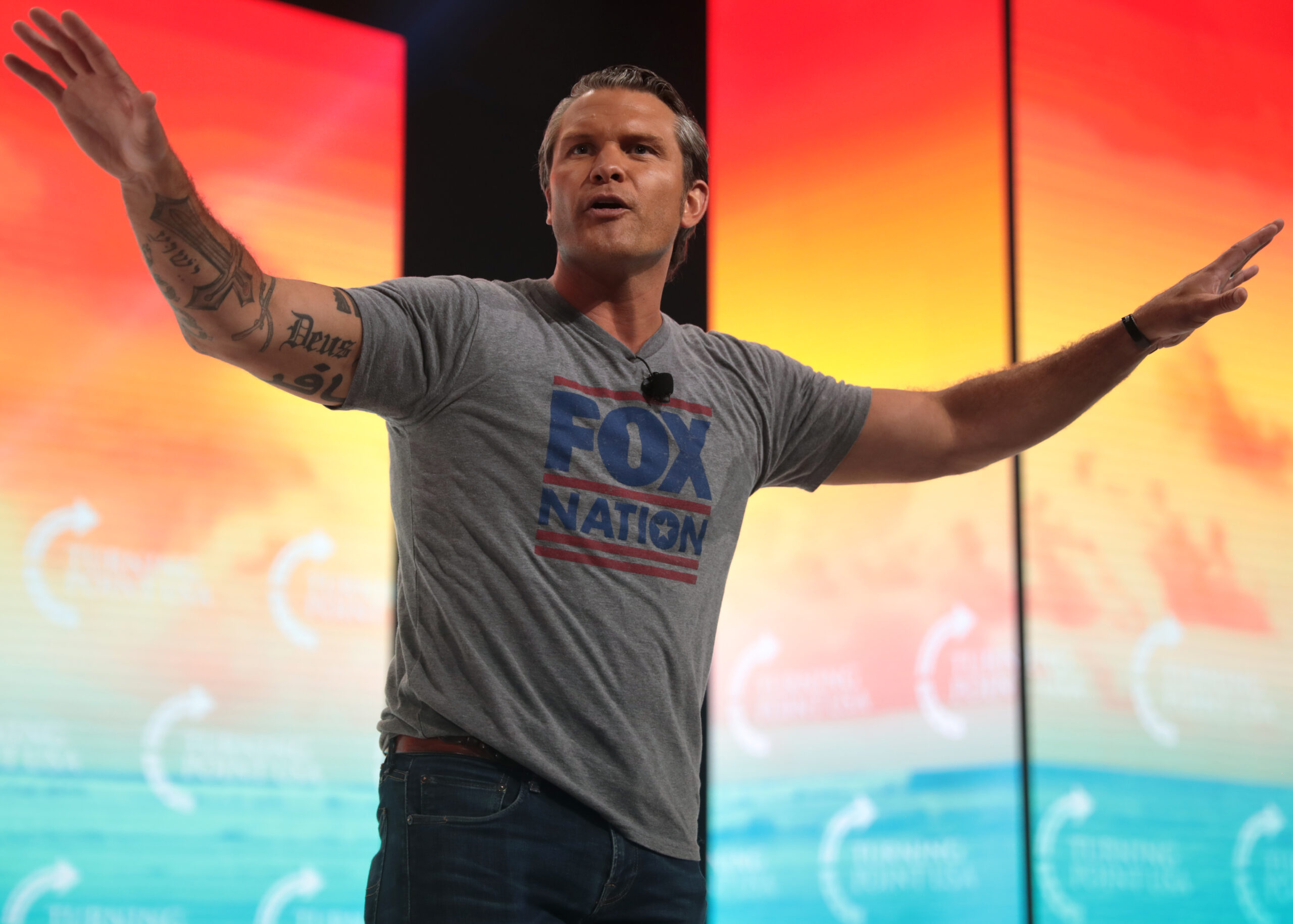
There is a tattoo on Pete Hegseth’s right bicep — one that he doesn’t hide. It reads Deus vult — Latin for “God wills it” — the battle cry of the First Crusade, shouted by Christian knights as they marched toward Jerusalem in 1096 to slaughter their way to the Holy City in the name of Christ. Hegseth has described it as exactly what it is: a Crusader war cry. He is not embarrassed by this. He is proud of it.
He should be, by his own logic. Because in the spring of 2026, standing before cameras in the Pentagon press room, the Secretary of Defence of the United States asked American families to pray — “on bended knee, with your family, in your schools, in your churches” — for victory in a war against a majority-Shiite Muslim nation. And he asked them to pray not to God in the broad ecumenical sense that has historically given American civil religion its inclusive veneer. He asked them to pray “in the name of Jesus Christ.”
The tattoo and the prayer are the same statement. One is spoken aloud and ephemeral — the other could have been on the front of a red baseball cap.
The Monument Moves In When the Argument Moves Out
There is a recognisable pattern in how power justifies the unjustifiable. Or, when they have really ‘stepped in it’. It does not begin with religion or civilisational mythology. It begins with conventional rationale — strategic necessity, national security, imminent threat, international law. These are the arguments that can be tested, interrogated, falsified. They exist in the domain of reason, and reason can say no.
When those arguments fail — when the evidence is thin, the legal basis absent, the strategic logic circular — something else moves in to fill the space. Something that cannot be interrogated, because it does not operate in the domain of reason. Something that answers every objection with a single, unanswerable reply.
“God wills it.”
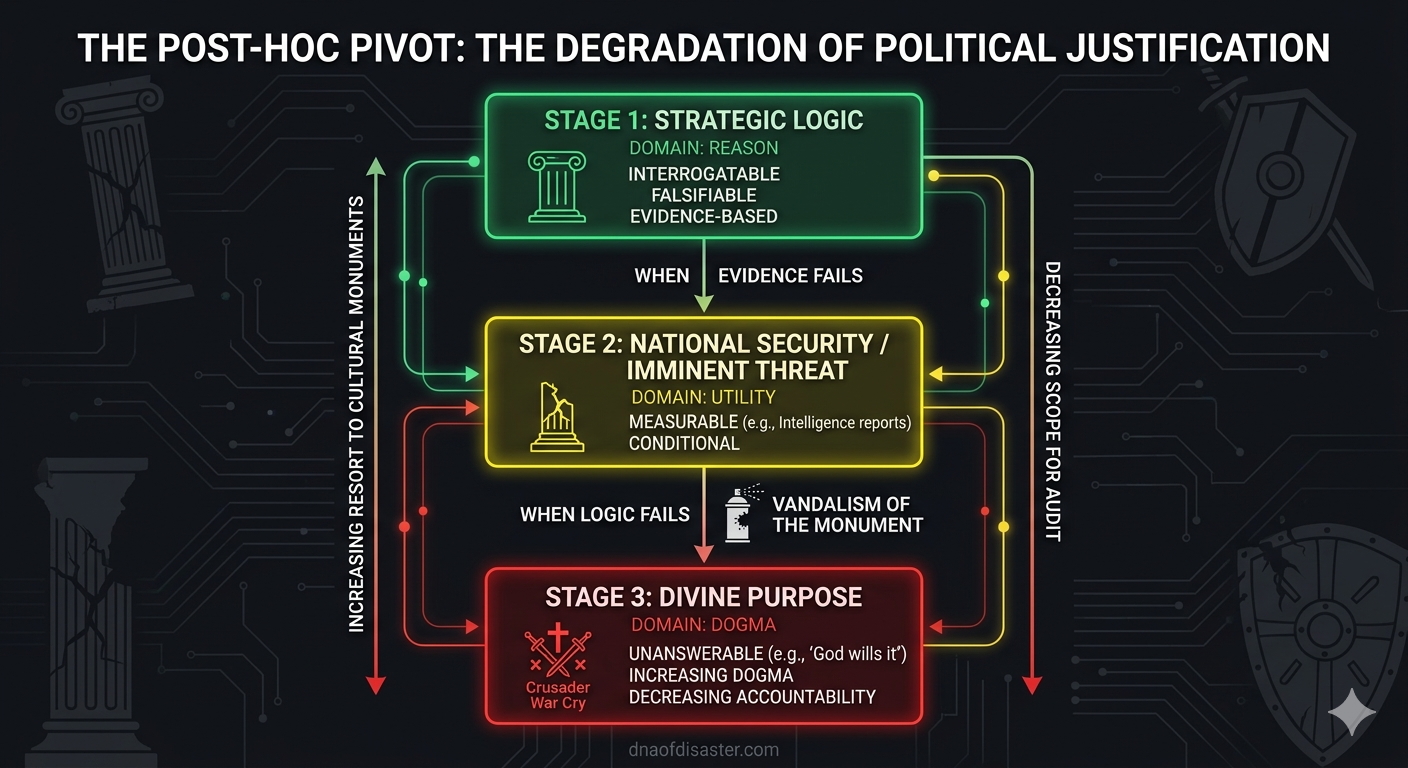
Figure 1: The Post-Hoc Pivot (DNA of Disaster Model). This diagram visualises the structural retreat power performs when it cannot justify its actions through interrogation. As arguments move from the ‘Green Zone’ (Strategic Logic) to the ‘Red Zone’ (Divine Purpose), they are deliberately placed beyond the reach of an ethical or strategic audit. The point of “Vandalism” occurs when the Cultural Monument is hijacked to serve as a non-negotiable conversation-stopper.
When nothing else can convince the masses — simply say that. Call upon the deity. Pretend you know what a particular deity wants — or even cares about for that matter.
This is what I call the weaponisation of a Cultural Monument. A Cultural Monument, in the sense I use the term, is a genuine inheritance — a value, an institution, a story, a symbol, a religion — that a civilisation has constructed over centuries and that carries real meaning for the people who live within it. Western civilisation. Christian heritage. The defence of a freedom. These are not fabrications built in haste to serve as an alibi. They point to things that are real, that matter, that have cost immense human effort and suffering to build.
The vandalism occurs when these Monuments are detached from their actual content — from the values and traditions they genuinely represent — and redeployed as rhetorical weapons to silence opposition and sanctify violence. The Monument stops being a source of meaning and becomes a conversation-stopper. A justification without a warrant. An answer that cuts the question off at the pass.
Hegseth has not invented this move. He has simply performed it with unusual transparency — which is either his great weakness or, in the current environment, his great strength. But does his stunt carry any weight?
The Crusade Made Literal
In his 2020 book American Crusade, Hegseth argues that the medieval Crusades — “bloody” and “full of unspeakable tragedy,” he concedes — were nonetheless justified because they saved Christian Europe from the onslaught of Islam. Without them, he writes, there would have been no Renaissance, no Reformation, no Europe, no America. “Do you enjoy Western civilisation? Freedom? Equal justice? Thank a crusader.”
This is the Monument in its purest form. History is compressed into a morality tale in which Christian warriors are the necessary precondition for everything good that followed, and their violence is therefore not a stain on civilisation but its very foundation. The bloodshed is laundered through the outcome. The means are consecrated by the ends — not strategic ends, not political ends, but ‘civilisational’ ends, cosmic ends, ends that God himself has so conveniently authored.
Now transpose that framework onto 2026. The U.S. and Israeli militaries are dropping thousands of bombs on Iran. A majority-Shiite Muslim nation. No formal declaration of war. No congressional authorisation on the public record. No imminent threat of the kind that would satisfy even a generous reading of international law. The strategic logic — whatever it is — has not been coherently presented to the American public, let alone to the world.
So what fills the gap?
Hegseth speaks of “overwhelming force.” Of raining “death and destruction from above” on “apocalyptic” foes. Of American capabilities, American will, American troops — and then, in the same breath, of “the providence of our almighty God” protecting those troops. The argument is not this war is necessary because [X] (insert whatever you didn’t prepare the public for). The argument is this war is sanctioned because [God said so]. The burden of proof has been outsourced to the divine, and the divine, conveniently, does not testify before Congress.
The Monument Stolen From Its Keepers
Here is where it gets theologically interesting — and where the vandalism becomes most visible.
Cardinal Robert McElroy of Washington, a senior figure in the very Catholic tradition that produced the Crusades Hegseth venerates, has stated plainly: “In my own view in the teaching of the church, this is not a moral war, it is an immoral war.” The Cardinal is not praying for victory. He sees a moral imperative to end it.
Pope Leo XIV — the actual head of the global Catholic Church, the living institutional successor to the popes who launched the original Crusades — has called for a ceasefire. “Violence can never lead to the justice, the stability and the peace that peoples are awaiting.”
The actual keepers of the Cultural Monument (the Catholic Church) have looked at what is being done in its name and said: “this is not ours.” They, especially, understand this adventurism is not the true nature of the keys to the kingdom. Instead, Trump, Hegseth and the entire cabal that has wrought this escapade have ‘blessed’ their own misadventure without asking for the benedictions from its actual keepers. They have stepped in as the keepers of these ‘keys to the kingdom,’ usurped their authority, and have bestowed concocted, corrupted benedictions upon their own creation — Operation Epic Fury.
Hegseth’s response, implicitly, is to reach past the current Church to an earlier, more martial version of it — to the era of Deus vult itself, when papal authority and military conquest were fused into a single enterprise. He has effectively performed a hostile takeover of a religious tradition, selecting a version of it that authorises what he wants to do and discarding the version that does not.
Franklin Graham, flanked by Christmas trees and a Hanukkah menorah at a Pentagon prayer service, supplied the theological infrastructure: “We know that God loves. But did you know that God also hates? Do you know that God also is a God of war?”
This is not Christian theology in any mainstream sense. It is Christian theology curated for a specific purpose — to place American military action beyond the reach of moral objection. If God hates the enemy and wills the war, then Cardinal McElroy’s moral objections are not just wrong — they are, in some sense, impious.
The Cultural Monument has been stolen from its traditional keepers and pointed at their heads.
The Structure Repeats
For those inclined to think this is specific to the Iran theatre, Hegseth has helpfully demonstrated the same architecture in Latin America. Countercartel military operations that have killed at least 157 people are framed not as security operations with measurable outcomes, but as part of a broader civilisational war against “godless narco communism.” Christian nations versus the forces of tyranny. The Monument moves in, the argument — which was on life support as soon as it was conceived — moves out.
The pattern is the architecture. The specific enemy is interchangeable. What remains constant is the structure: “we cannot fully justify this in the language of law, strategy, or proportionality, so we will justify it in the language of civilisational destiny.” And civilisational destiny, by definition, is not subject to audit.
What This Costs
Cultural Monuments are not infinitely durable. Some are torn down almost as soon as they are constructed. (Look at the USSR) Others— which were begun in the distant past— have demonstrated far more durability. They are built over centuries but they can also be degraded — not quickly, but steadily — by exactly this kind of instrumentalisation. When the language of Christian civilisation, Western heritage, and divine sanction becomes reliably associated with bombing campaigns launched without legal basis, something corrosive happens to the Cultural Monument itself. The words begin to mean ‘violence dressed in God’s vestments’ rather than the genuine inheritance they were meant to carry.
This is the deepest irony of Hegseth’s project. He believes he is defending and restoring Christian civilisation. He is, in fact, spending it — converting its symbolic capital into short-term political and military cover, degrading the currency with every use.
The Crusaders he venerates eventually lost Jerusalem. They also left behind a legacy so contaminated by violence and conquest that a thousand years later, Deus vult functions less as a statement of faith than as a warning sign — the kind of phrase you tattoo on your arm when you want people to know exactly what kind of wars you are prepared to fight.
Pete Hegseth has been very clear about that. We should take him at his word.
This essay is part of an ongoing series applying the DNA of Disaster framework to contemporary political events. Comments and pushback welcome.
Kind Regards,
Devin Savage
Tübingen
Research assistance using Claude.ai and Google’s Gemini.