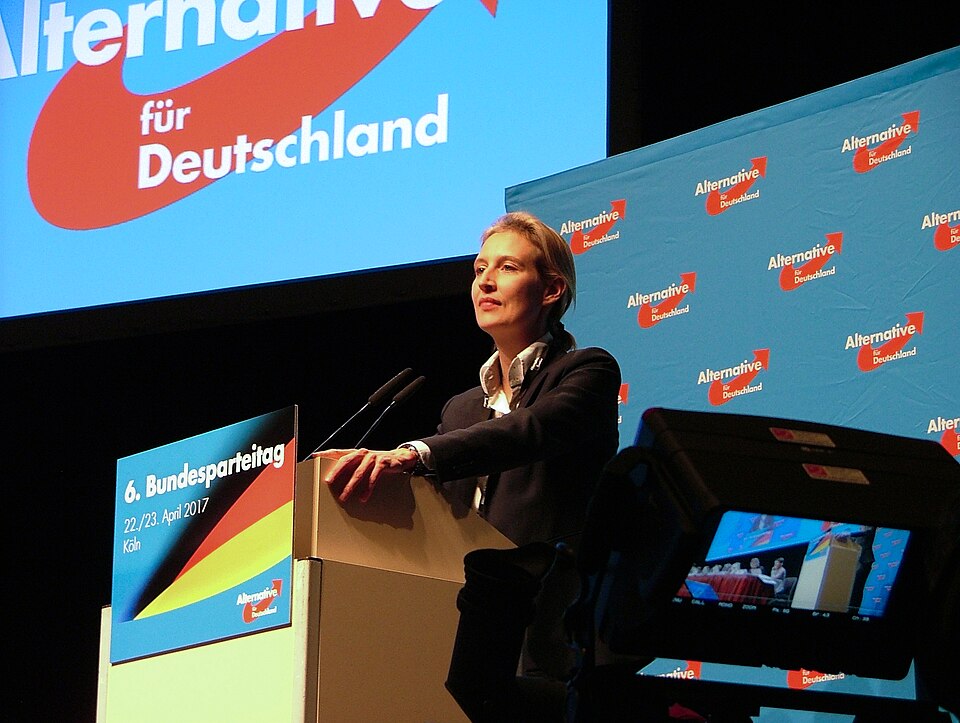
A Watershed Election: What Happened in Saxony-Anhalt Yesterday? We have seen it before.
Devin Savage
dnaofdisaster.com | September 7, 2026
I. The Coalfield Curse
On 6 September 2026, the AfD won Saxony-Anhalt with a wide plurality — 43.9% of the vote, 39 of 83 seats, a swing of more than 23 points since 2021. The CDU, which had governed the state in one coalition or another since reunification, collapsed from 37.1% to 17.2%. This is not a protest vote at the margins. It is a plurality of an electorate choosing the party that Germany’s own domestic intelligence service has classified as right-wing extremist in that state — a designation the courts have already confirmed for the AfD’s branch in neighboring Saxony, a separate state; Saxony-Anhalt’s own case is formally on hold, pending a related federal-level ruling in Cologne. ‘Extremist’ is not a label applied lightly. I take that seriously; there are true believers in that leadership who mean exactly what the designation says. But a movement’s leadership and a movement’s electorate are not the same population, and the interesting question isn’t whether the label is accurate at the top. It’s why 43.9% of voters were willing to hand power to it anyway. The mechanical underpinnings of that decision look more like backlash than conversion. Why?
I’ve watched this movie before, in a different theatre. I saw the employment centres of southeastern Ohio and the Ohio River region get unplugged by NAFTA and the decline of coal country. And Saxony-Anhalt’s political arc has a mirror image sitting six thousand miles away, in a place that used to vote the opposite direction entirely: West Virginia.
The two regions are separated by an ocean, a language, and an entirely different political system, and yet they are running the same structural programme. Both were built on coal. Both watched the industry that built them get phased out by forces well above the local level — for West Virginia, the slow post-NAFTA starvation of jobs combined with the decline of Appalachian coal; for Saxony-Anhalt, the accelerated post-Fukushima exit from nuclear power, which created an energy gap that got filled, for a decade, with the dirtiest fossil fuel there is: the region’s own brown coal. Having leaned on it, Berlin then legislated the whole industry out of existence a few years later, with a hard exit date of 2038.
And in both places, the exit was supposed to be highly managed- the cushioned kind of landing. Clinton’s answer to NAFTA’s casualties was a retraining pledge — at the signing ceremony itself, he challenged Congress to build “the world’s best worker training and retraining system.” What arrived, the NAFTA-TAA programme, was chronically underfunded and too bureaucratic to keep pace with the job losses it was meant to offset. Germany’s version is better funded on paper — €40 billion federally through 2038, of which €4.8 billion is earmarked for Saxony-Anhalt specifically — but the money has run into the same problem every managed-decline package eventually runs into: the gap between what a spreadsheet in ‘central command’ (Berlin) calls a fair trade and what it feels like on the ground in Zeitz and Magdeburg.
Three complaints do most of the damage. First, “ghost projects” — money that shows up as standard municipal spending rather than a direct replacement for a mining job. The most-cited local example is money from the coal fund going toward restoring Naumburg Cathedral; to a laid-off miner, that reads less like structural transformation than like Berlin finding cash for a tourist attraction it couldn’t spare for his retraining. Second, a status downgrade baked into the replacement work itself — a unionised, lifetime engineering job at a coal plant traded for a service-sector post at a newly created resort lake (the mines and open pits were filled with water for tourism) or a municipal museum — doesn’t just pay less, it’s a demotion to boot. When you take a man’s job away, you take away the source of his pride. Let’s not pretend retraining will make him whole again. That would be the best case scenario; but the least likely outcome at the same time. Government policy is famously hit-or-miss. Or more likely miss-or….hit. Policy often succeeds — when it does succeed — by accident, not by design.
Third, the money is largely invisible on the actual timeline that matters to voters: big infrastructure and hydrogen-economy projects take years to clear planning and environmental review, so the pain of the phase-out lands immediately while the promised “green industrial future” remains mainly theoretical- popping up every now-and-then on a press release or a news segment. The AfD’s own platform in this election explicitly calls for halting the green subsidies and re-extending the life of the coal plants — which tells you exactly which of these three complaints they think has the most populist bang for the buck. Do you remember Clinton promising the workers of Coal Country that he would protect union jobs? And do you think there just <may> be a problem when a politician says he can buck economic reality? Hmmmm. The soviets tried to buck economic reality. We saw how that worked out.
II. Voting with their Feet
What happens to areas with economic challenges? People who can leave — often do leave.
Both the German and American regions lost their youth to these hardships, rescue package or not. Saxony-Anhalt has shrunk by roughly a quarter since reunification and now carries Germany’s highest average age, 48.3; West Virginia lost population every year of the 2010s, the only state in the union to do so, and its old coal counties are watching median ages nearly double as schools and hospitals consolidate around them. And in both places, when the young leave, they don’t just leave — they take the next generation’s births with them.
Both regions, too, had voted reliably left for generations, because the left was the party of labour and union protection. And in both cases, the mainstream left drifted toward socially progressive, urban, environmentally-coded politics, and the people left behind in the coalfields felt this ‘exit’ long before anyone in Washington or Berlin admitted it out loud. Right-wing populism didn’t have to argue its way into that vacuum. It just had to show up and claim to be the last one still speaking for the people who got left behind.
Trump took 70% of the West Virginia vote in 2016, 2020, and 2024. The AfD has just taken Saxony-Anhalt by a similar margin. This isn’t mystery. It’s the coalfield ‘curse’, running on schedule- different country, for sure. But the underlying mechanism? It’s the same. Almost identical.
III. Humans Do Not Need to Be Taught Fairness
But economic abandonment is the backdrop, not the trigger. The trigger is something older and less negotiable, and it’s worth being precise about what it actually is, because the mainstream commentary almost never gets this part right.
Humans do not need to be taught fairness. They track it instinctively, from early childhood. The developmental economics (aka: human behaviour) on this is well established — Ernst Fehr, Helen Bernhard, and Bettina Rockenbach’s landmark work on inequality aversion in children found that somewhere between the ages of three and eight, kids move from pure self-interest to a sophisticated, constant monitoring of how resources are divided. And critically, what they demand isn’t flat equality. It’s proportional division, tied to merit, effort, and what a person can be said to have earned. The Little Red Hen was published in 1918. It was a timely counterpoint to the events in Russia at that time- the book represents rugged individualism and the capitalist meritocracy. The hen puts in the individual labour (planting, reaping, threshing, baking) and therefore owns the final product (the bread). This ‘fairness’ feature of human cognition begins at an early age and is reinforced constantly in daily life. When the protest comes, it is almost never the logical “I don’t have enough.” It’s the far more emotional and subjective “they got more than they deserved.” Humans understand the pie (or the loaf) is only so big, and it can only go so far. It’s the fair distribution of the limited resources that are available that counts. This instinct is hard-wired. It cannot be lectured or scolded out of people.
The AfD doesn’t need a policy platform sophisticated enough to out-argue this instinct, because it isn’t arguing against it — it’s activating it. Fehr and colleagues also found that this fairness-tracking is deeply entangled with in-group favouritism: what they call parochial inequality aversion. Frame immigrants as new claimants on a finite welfare system — housing, healthcare, subsidies — and you trigger the oldest complaint children have ever made about their siblings: someone is cutting the line. (See my blog post on council housing allotment in Ireland).
This isn’t unique to Germany, and it isn’t a right-wing invention. Herbert Kitschelt and the researchers who followed him (Anthony Heath, Jens Rydgren) have documented for years that support for the welfare state doesn’t erode because people suddenly turn hyper-capitalist. It erodes because the boundary of who’s included in “us” gets redrawn. The social contract runs on perceived reciprocity — I pay in today because you paid in yesterday, and we both benefit tomorrow. Decouple redistribution from that reciprocity, apply it to a group that hasn’t yet had the chance to pay in, and the reaction isn’t a tax-policy debate. It’s a visceral rejection of what feels like an unearned claim on scarce resources. It’s a broken feedback loop— yet again. Even the famously egalitarian Scandinavian welfare states have watched their own consensus fracture along exactly this line.
IV. The Shock of Suddenness
What makes this German (and recently French) moment so combustible is that it doesn’t just redraw the boundary of solidarity — it redraws it overnight, at a scale not many had predicted. But should we be surprised?
If a family adopts a child, the existing kids get time to adjust, to recalibrate, to build a new routine around the new sibling. If the parents instead come home one afternoon with five new children, unannounced, the existing kids don’t experience an adjustment. They experience a shock. Germany took in over a million asylum seekers in 2015–16, and kept absorbing new waves after — Ukrainian refugees among them — at a pace that compressed what should have been a generation’s worth of demographic change into a handful of years.
And it wasn’t experienced as an organic shift. It was a decision — made at the top, by one chancellor, condensed into three words, “wir schaffen das,” without the kind of prior national debate that would have made it feel like something the country had actually agreed to. To the voter who feels this way, the state didn’t invite a conversation. It issued a decree, and expected the ‘household’ to adjust its own arithmetic around it.
That decree became visible fast, and visibility is what turns an abstraction into a grievance. Gymnasiums became migrant housing. Classrooms filled past capacity. Physicians’ offices absorbed a new population with its own health burdens — a physician friend of mine whose practice includes Ukrainians, sees a steady stream of unusual conditions tied back to Chernobyl radiation, decades on. Administrative backlogs grow. Now we’re being told the German healthcare system is groaning under the pressure, and a major overhaul to funding is coming.
For a place like Saxony-Anhalt — which had already spent three decades watching its youth leave, its infrastructure age out, its schools consolidate for lack of children to fill them — the sudden discovery of state capacity felt less like generosity than betrayal. The grievance was rarely “I am starving.” It was closer to: the state told us for thirty years there was no money for us, and then found billions overnight for people who haven’t yet contributed anything to this country, its institutions, its social safety net, its cultural monuments, nor its upkeep.
Populists don’t need a macroeconomic argument to make that land. They need a single, legible story: the rules of the household changed, and nobody bothered to ask the existing kids first. That’s a story anyone can understand, and almost nobody can easily refute, because the culpability it assigns comes with its own visible evidence attached.
V. It’s [not] Racism, Stupid
The lazy version of this analysis stops here and calls it xenophobia, or worse, calls the population of the former East inherently racist. That diagnosis is comfortable for the people making it, and it explains almost nothing. I’m not saying racism is not in the equation, I am saying it’s complicated.
What actually happened in 2015 wasn’t simply that refugees arrived into Germany. It was that the implicit rule of consultation got broken. A nation’s accumulated institutions — its welfare state, its infrastructure, its trust — function, in the eyes of the people who built and inherited them, as a collective inheritance. When the custodian of that inheritance makes a unilateral decision to extend membership to millions of new claimants overnight, without the deliberative process that would normally confer legitimacy on a decision of that size, the backlash that follows looks like ethnic hostility on the surface. Underneath, it’s a due-process objection: the state broke its own rule about consulting the family before changing who’s in it.
This reframing matters, because it’s a genuinely different diagnosis than “these people are bigots,” and it points toward a different question — not how do we make people less racist, but what does legitimate, consultative admission into a shared inheritance actually require, and did this process meet that bar or not. German people to Ms. Merkel: It did not.
According to exit polls released during the September 6, 2026 election in Saxony-Anhalt:
Exit polling indicated that around eight in ten AfD voters in Saxony-Anhalt cited migration as their top issue. [1]
Recent longitudinal analysis of SOEP data (2014–2024) by Martin Schröder and colleagues finds that concern about immigration alone accounts for roughly three-quarters of the explainable variation in AfD support and about 90% of the explainable variation in actual AfD voting. By contrast, income, education, and subjective ‘left-behind’ feelings add little once migration attitudes are controlled. When an individual’s migration concern increases markedly, their probability of supporting the AfD rises by around 20 percentage points.
From this data one can see that the average AfD voter fears something that is very unlikely to affect his daily life. There are both obvious and hidden central pillars of his discontent that cannot justly be blamed on immigrants. But the immigrants are legible, they are visible, and they form the potent basis of populist rhetoric. And they are also the visible, legible culpability of a decree from above- the leftovers of a major ‘family’ decision that did not include them.
VI. Blue-Sky Custodianship
Every nation’s accumulated achievement — its institutions, its prosperity, its religion, its culture — functions as what I’ve elsewhere called a Blue-Sky Cultural Monument: the pinnacle of a long accumulation of labour, trust, and hard-won stability. Heroes, hardships, national prosperity. The pride of being from such a nation — and the harnessing of that pride. People who feel they had a hand in building it, or inherited a claim on it from those who did, expect a say in what happens to it next — including who gets to share in its custodianship and who gets the benefit of it being handed down to them. Whose progeny get to inherit Germany (or France) -? German or French or any such culture- the pinnacle of centuries of creating, of building, of conserving, is considered to be the pride of nations. Who gets it in the end? The great hope is the nation and its culture will be conveyed intact to those who will cherish it, who maintain it and conserve it for the future. It will not be left to chance- and it should not be left to just anyone who wanders in. (added on 22 Sept, ’26: I want to say now what should have been obvious when I wrote this piece two weeks ago, the great hope also includes that the ‘nation’ should be handed down to those who deserve it, i.e. those who are the legitimate heirs of those who built it à la The Little Red Hen. We should not condemn as racists those who feel this way, it’s a normal human response. Just the same as handing down the family farm to the kids and grandkids. For whom were they sacrificing and working so hard, anyway? Should their cities and towns, fortunes and heirlooms be handed to the state for redistribution? I cannot blame them (AfD voters) for this very normal, very human response. Germany may be struggling demographically with a low birth rate among ethnic Germans, but it’s not as if Germany has been left as derelict, abandoned for resettling by millions of complete foreigners. Not just that, but young foreigners as well, and what is quite obvious on the streets of German cities and towns that Germany is fertile soil indeed for this new, expanding demographic. Expanding despite that they do not compete head-to-head, on equal terms, in the German housing market and economy. Those who are too intellectually lazy to examine and observe the nuance here deserve their political fate. Yes, THIS is the power of populism. The void here has been, at least partially, intellectual, in my opinion.)
That’s the opposite of how people relate to a Dark-Sky Monument. Nobody has an identity crisis over who “owns” Chernobyl, or the legacy of a totalitarian regime nobody wants credit for. Ownership anxiety is specific to the things people are proud of. The moment the custodianship of something valued starts to feel altered without permission, demographic change stops registering as ordinary social evolution and starts registering as an existential threat to that culture: a defacing beyond all recognition. Cultures change- but naturally, historically, at a glacial pace. Call it Kaizen, but it should be slow.
Something new needs time to assimilate- especially before the next new thing.
The graffiti artist becomes concrete on the street. German women, especially those in the workforce, have spent decades adjusting to an economy that makes large families hard to sustain — later marriage, fewer children, more years in paid work. The economic realities of living in a western capitalist country — with its structural scarcities. Set that reality next to the highly visible sight of young migrant women pushing prams with several children in tow, supported by the same welfare infrastructure, and the arithmetic just feels wrong to many. I think it’s lazy to brand it with slurs. The domestic population is told to tighten its belt for certain reasons. Pony up more for healthcare. Then that same population witnesses, in plain sight, the state fund the raising of a new population that arrived without proper consent; without public discourse, and without the ballot box. Hubris indeed.
Stay Tuned- I’m thinking about this more, I may have some further comments and discussion to add later this week. I welcome your comments as well. (See my new comment above added 22 Sept, after the Berlin and Mecklenburg-Vorpommern elections)
Sincerely,
Devin Savage
Tübingen, Germany & Dublin, Ireland
Research assistance using Claude.ai and Google’s Gemini and a bit of spot-checking with Perplexity.
—
Notes:




2 responses to “AfD and the Power of Populism”
I really like this blogpost. I also think it’s not so simple as labeling the people xenophobes. The former East Germany had many personality traits that persist today a little more muted maybe. In the DDR, people were not loathing dependence on Russia like unified Germany is. The AfD also does not paint Russia as the villain.
Very few foreigners lived among the East Germans, and these workers were segregated from the general public.
There was no reckoning with the guilt from the Holocaust in the DDR as there was in the West, so they see little wrong with “othering” immigrants rather than acting in a generous spirit toward them.
Many from the former DDR thought the reunification was handled poorly and reduced them to second class citizens in the unified country. Many who have lived under both systems of government think that in the DDR, crime was lower, self esteem was higher, women had more equality and representation in the workplace, people were closer knit and less selfish, and health care was better.
So I think many in the former DDR glom onto the AfD because it speaks to their grievances and empowers them to reclaim some of their former pride.
This is a great comment, and it highlights a bit of a gap in the blog post. I had covered the more surface stuff- those things that the Saxony-Anhalt region shares with WV, but I didn’t really cover the more cultural-orientation stuff. So- what you brought up almost deserves its own treatment on a separate blog post. I looked up some of the available stats and it seems that back in the day, the DDR had only about 1% of the population as foreign born. This seems to make sense when you take note of the fact that the DDR had to practically hermetically seal the border, to keep its citizens from escaping to the West. (I remember how a friend had escaped) So people were not exactly tripping over each other to get into the DDR. This contrasted with about a 7% foreign-born population of western Germany around that time. I would imagine that that 1% may have self-deported the instant the Wall came down. But you know how the newly indoctrinated are… so I could be wrong about that. But the point here to note is that the citizens of the former DDR just had less contact with outsiders, and so this fits in with the usual suspicion of foreigners. One thing I don’t know is whether or not this 1% number includes Russians, who, I assume, were a requirement in the DDR for ‘guidance’ and to ensure strict compliance with mission control in Moscow. But for what we are talking about here- I doubt any Soviet contingent in the DDR would have had lasting effects so many years later. But the same goes with the former DDR after reunification. One would expect a number of people to have been making their tour through the DDR to ensure compliance with the wishes of Bonn after Reunification. But the fact remains that many citizens of the former DDR would have had little contact with outsiders, and their opinions- being that the region is about the average age of 48 years- would have been formed many years earlier and much more of an eastern influence as well. The other nut to crack here is that the DDR had built its foundational myth around the fiction that the DDR was the anti-fascist state, and therefore was the inheritor of the ‘nazi-less’ future. You can just imagine what they were told about western Germany. And this was for all those years prior to the Wall coming down. Did this prime the citizens of the former DDR to be more likely to see western Germans as the ‘other’ or outsiders? Perhaps. But another factor that you brought up is that with its minimal exposure to the Allied powers (except for Russia) the opportunity for moral reckoning and collective soul-searching about the Holocaust did not present itself in the same way as it did for West Germany.
The other factor that comes to mind here is that of the historical butt of jokes. I have heard there are jokes about former eastern Germans, at least in the years shortly after the wall came down. There were also jokes about West Virginia. I heard many of them when my parents moved us to Ohio in the 1970s- I remember one about the new Silver Bridge crossing the Ohio- the old one fell down into the river in the late 1960s, I remember seeing the pieces of steel jutting upwards when my parents were there visiting family in the late 60s. The new bridge went up. The jokes- one of them “We have a new bridge! Now the West Virginians can swim across in the shade!” etc. Is there a cultural aversion to being associated with WVa? Maybe, maybe with some people. As the only state in the union which lost population- there is at least some evidence that could contribute to that. But there could be just enough bias to prevent WVa’s economy from stepping forward with progress. Here is where the similarities with Sachsen-Anhalt come in. Both are seen perhaps a bit like a place you only go if you are foced to go, and would never dream of actually putting down roots there. (Like Mississippi maybe?) Not total isolation but quasi-isolation, de facto.
So if you look at what AfD actually gained- it’s not in the same league as Trump in WV. Granted, there is a difference in the mechanics of the vote that refllects the mechanics of the actual function of the elected officials, but AfD is not sweeping its way into power like Trump and his backers did. And this is in it’s so-called stronghold. This doesn’t look like a trend to me. I think the AfD platform will go down like a lead balloon in the Western/Southern parts of Germany. This is the same country that shut all the nuclear plants after Fukushima. Are they going to grit their teeth and vote for people who are ready to back Putin and throw the Ukranians under the bus? Who are willing to fire up the old generating plants using the same brown, stinky, polluting coal from Saxony-Anhalt? Cozying back up to Putie and torching the environment again will not play well in the Germany that I know (and live in).