The Machine That Fails Regularly, and Something That Isn’t Allowed to Fail at All
Devin Savage
dnaofdisaster.com | June 13, 2026
My father’s 1970s Fiat convertible was, by any objective metric, a mechanical disaster. It had a temperament as volatile as it was predictable, offering a masterclass in reliable unreliability. In Germany the joke is that FIAT stands for Fehler in allen Teilen — loosely, “a mistake in every part.” I have also heard the “fix it again” joke, and the one about a failed attempt at transportation. Jokes aside, we loved that car anyway. It was perhaps a bit hard to love: a noisy rag-top with no back seats, just a little bench with a hard surface and no real cushioning to speak of. I do not remember there being seat belts in the back at all. Dad usually drove it to work, but on weekend drives two of my brothers would perch on that bench, I rode shotgun, and my father shifted gears through Sacramento. Lots of fun. But it was not my mum’s sort of car. She had a Pontiac that would have seemed enormous parked next to the little Italian roller-skate. But for that time, the Fiat was Dad’s dream machine — as long as his toolbox was nearby.
In the summer of 1975, Dad and I drove from California to Ohio to visit my grandparents, and the car shed its fan belt in the arid heat of the middle of rural Nevada. We managed to hitch a bone-rattling ride with a semi-truck driver back to civilisation. Walking into a dusty desert repair shop hoping for a replacement part for an obscure Italian sports car felt like looking for flying pigs. Miraculously, the mechanic unearthed something close enough to keep us rolling. More than fifty years later I can still see his wall of belts in my mind’s eye. The lesson was simple: we take comfort in predictable flaws. We can plan around the devil we know. Broken fan belt? That- we can fix.
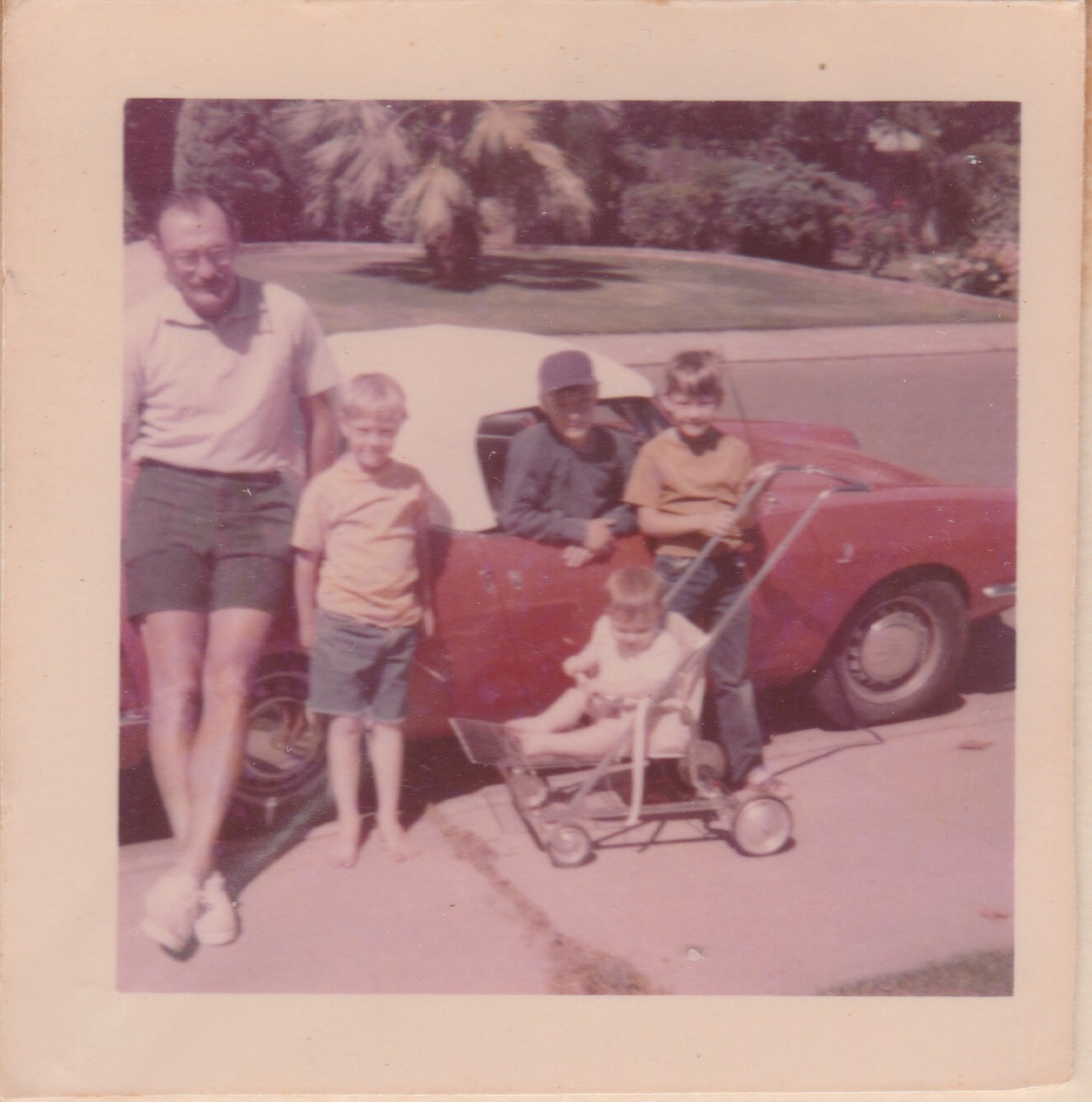
The Savage brothers & Dad. Summer 1974.
This quirk of psychology helps explain why our modern relationship with technology is so fraught, particularly when it comes to self-driving cars.
In America, human drivers kill roughly 40,000 people every year. That staggering loss of life has become cultural wallpaper. It is a background noise we accept with a collective shrug: a tragic but expected tax on personal freedom. We understand human error; it is predictable in its frequency and born of familiar failings. Distraction, exhaustion, bad judgement, street racing, drink-driving — all the ordinary sins. Predictable. No surprises here.
Autonomous vehicles, by contrast, promise near-perfection. If not today, then someday they will outperform human drivers. Statistically, they already have the potential to be far safer than the average teenager, the distracted commuter on a smartphone, or the motorist half-distracted by hair, make-up, or anything else. Yet when an autonomous vehicle makes a single, unpredictable mistake — say, failing to recognise a pedestrian in a situation a human would easily handle — the public reaction is immediate and fierce. One catastrophic error does not just produce a police report; it triggers hearings, suspended testing programmes, and a national referendum on whether the technology should exist at all.
We punish the unpredictable error of the machine far more harshly than the routine failures of humanity. A predictable flaw, even a fatal one, allows us to preserve the illusion of control. But a machine that is almost perfect right up until the moment it fails in an incomprehensible way terrifies us. Managing the known chaos of a broken fan belt in the Nevada desert is understandable. Surrendering our trust to an almost flawless system whose rare errors we cannot anticipate is another matter.
The Mechanism
This double standard is not mere irrationality; it is rooted in the stubborn machinery of human risk perception. Decades ago, Paul Slovic mapped this quirk of judgement, showing that we do not measure danger with mathematical logic, but through what he called an “affect heuristic*” — a gut-level response shaped by control and familiarity. Affect is a clinical term used to describe the appearance on a patient’s face for example, such as a grimace when they bend over to pick up something and experiences some discomfort. Basically it means how someone feels at that moment — reflecting the inner emotional state as well as personal discomfort. Slovic’s research suggests that we will tolerate risks that are vastly greater if they feel voluntary, familiar, and under our own control. Driving a traditional car is an act of agency. But we do not control the weather, the road surface, or the erratic actions of everyone else on the road — and yet our hands are on the wheel, our feet on the pedals, and somehow the whole gamble feels distinctly ours. An autonomous vehicle, however, asks us to surrender that agency to a corporate algorithm. Because the risk feels involuntary, external, and alien, our minds inflate it into something much larger than it is.
When that unfamiliar technology stumbles, a second psychological trap appears: algorithm aversion. Recent research in psychology has shown that our trust in code is brittle. We expect digital systems to be nearly perfect; because computers do not get tired or drunk, we unconsciously grant them very little room for error. Their studies suggest that people will happily use an algorithm when it outperforms a human expert — until it makes one mistake. Then trust can collapse almost immediately, and the system is treated as if it has been discredited for good.
This asymmetry exposes a deeper fault line in how we assign blame. The native error is an incident; the foreign error is a verdict. When a human driver crashes, we isolate the tragedy, attributing it to fleeting circumstances — black ice, sun glare, a momentary lapse in judgement. It is an incident, a localised event that leaves our faith in human driving intact. But when an autonomous car fails, we treat the error as an indictment of the whole system. The machine cannot have a bad day or a stroke of bad luck. Its singular mistake becomes a verdict on its entire class: a fundamental failure of identity that renders it unfit for our roads.
We remain locked in this paradox, paralysed by the incomprehensible errors of a superior machine, while safely insulated by the comfortable familiarity of our own flaws.
The Human Import
On the late evening of Monday 8 June 2026, a man was stabbed on a street in north Belfast. The attack was captured on video: the attacker sat on top of the victim, slashing him about the face and neck. The footage went viral within hours. A Sudanese-born resident of the United Kingdom was charged with attempted murder. At the time of writing, nothing is known about the motive for the attack.
What followed had nothing to do with motive, or with the attacker, or even with the victim. By the following night, masked men were burning the homes of strangers with no connection to either man. Houses, buses, and other property were torched on little more than proximity and a guess about who might live behind which door.
None of this happened in a vacuum. The Belfast attack landed on ground that had already been carefully prepared, the latest turn in a sequence that has become almost liturgical.
In the summer of 2024, a seventeen-year-old walked into a children’s dance class in Southport, England, killed three young girls, and injured ten other people. Within hours, a fiction had taken hold online: the killer was said to be an asylum seeker, a fresh arrival, an undocumented migrant. That fiction did its work. Riots spread through more than a dozen towns across England and Northern Ireland before the truth caught up. The attacker was a British citizen, born in Wales to parents of Rwandan origin. But the houses had already burned.
A year later, in July 2025, the sequence ran again in Ballymena, Northern Ireland. Two fourteen-year-old boys were charged in connection with an alleged sexual assault on a girl; both denied the charges, and both required a Romanian interpreter in court. That single detail — the interpreter — was enough. Agitators fanned outrage into days of disorder, and once again homes and shops went up in flames.
And in the week before Belfast, the pattern surfaced in a different key. In Southampton, an eighteen-year-old student named Henry Nowak had been fatally stabbed the previous December; his attacker was a British-born Sikh man. When footage emerged showing police handcuffing the dying teenager after apparently accepting the attacker’s account at the scene, outrage followed quickly, and populist race-baiting was not far behind. Nigel Farage declared the police response evidence of “anti-white prejudice”, and the night after the footage circulated, a protest in Southampton devolved into violence.
So by the time the Belfast video began to circulate, the machinery was already warm. Far-right figures using anonymous accounts called crowds into the streets and demanded that the United Kingdom expel millions of its foreign-born residents. The grievance was stoked and waiting; the stabbing merely ignited the kindling.
The Verdict on the Ground
To understand the absurdity of this double standard, one only has to look at the ground on which these riots took place. Northern Ireland, of all places, knows exactly what havoc can be wrought by home-grown men with weapons and bomb-making materials. For three decades from the late 1960s, native-born citizens were caught up in a bitter sectarian conflict that cost thousands of lives. Yet that generation of domestic terror has been folded into collective memory as a localised political tragedy, handled case by case. Like the annual highway deaths in America, the potential for native violence is treated as wallpaper: expected, understood, and to a degree fatalistically forgiven as part of the cultural landscape. It is a native error — an incident.
Nobody, surveying thirty years of carnage, delivered a verdict on the essence of the people of Northern Ireland. The violence was attributed to politics, to history, to circumstance, and to the many flawed human beings who drove it forward. Some of the most prominent figures eventually softened their views (Think: The Rev. Ian Paisley), demonstrating the human capacity for change and redemption — the moral cushion we reserve for our own.
But when a single man from Sudan commits an act of violence, the mob delivers a verdict on an entire demographic. Suddenly, all foreign-born or dark skinned residents are indicted, hunted, and condemned categorically.
The exception, tellingly, proves the rule. When Troubles-era violence crossed the Irish Sea, Irish communities in Britain became a “suspect community” — collectively profiled after every bombing. The moment the error was perceived as an import, the verdict mechanism switched on.
This is Paul Slovic’s risk perception playing out in real time. On the streets of Belfast, and then — as the Irish crossed the Irish Sea — on the streets of England too. The water between them changed nothing. They became the outsiders, the suspects, the risk nobody had consented to. They became guilty as they crossed that water, by nothing more than association; by the point of embarkation. Involuntary, unfamiliar, imposed from outside. Because the foreign resident is viewed through the lens of algorithm aversion, they are judged by an impossible standard of absolute perfection. Anything less is treated as a systemic failure of identity, and therefore as grounds for expulsion. It is an exquisite irony: a society that has spent generations navigating its own violent and deeply flawed history now demands flawless behaviour from the outsider. No human population has ever met that standard, least of all the one doing the judging.
Disasters by Design
This psychological vulnerability does not exist in a vacuum; it is weaponised by a system that seems practically engineered for chaos. Seen through my Disasters by Design framework, the cascade has now run at least three times on the same predictable timeline: Southport in 2024, Ballymena in 2025, and Belfast in 2026. The anatomy of the failure is consistent. First comes viral footage or distorted rumour. Next comes rapid social-media mobilisation by recurring agitators. Then come arson and street violence within twenty-four hours. Finally, the official appeals for calm arrive long after the petrol bombs have already detonated.
When an algorithm or a vehicle makes a mistake, we call for hearings and demand that the technology be constrained. Yet we tolerate an information infrastructure that routinely helps set cities on fire. A system that produces the same catastrophic failure three years running is not merely having accidents; it has a design flaw. Or, more precisely, it has been exploited in ways that reliably produce the same result: indignation first, chaos second.
Here the automotive comparison stops being a metaphor and becomes a diagnosis. The most important system on any car, after the steering, is the brake. My father’s Fiat was a rolling catalogue of failures — belts, electrics, even the badge was a source of ridicule — but the brakes worked, and so every breakdown ended at the side of the road rather than in a ditch. Brakes — functioning properly — save lives. In my framework, it represents a veto-node: the point in any system where a human being or a mechanism can interrupt the cascade before it completes- before the crash, before the catastrophe.
Our online information ecosystem is a machine of magnificent acceleration with no brake fitted at all. There is no functioning veto-node between the video on a smartphone screen and the burning house on the corner. Platforms will not act in time, because outrage is their fuel and no business voluntarily installs a device that limits its own throttle. Police can only react after the fact; they are the airbag, not the brake. Political incentives point the wrong way too: there are votes in the fire, and none in the extinguisher. Without a veto-node, the chain reaction is absolute. The riot is not a spontaneous response to a disaster; the riot is the disaster, and its execution was already encoded in the architecture of the system.
This systemic failure is supercharged by two human follies. The first is an error in attribution: the irrational assignment of a coordinated, malicious effort to the entire imported group. The mob looks at an individual crime and hallucinates a collective conspiracy. The second is an error in trust: the blind assumption that what they have been shown is clean, objective fact. In reality, they are consuming a manipulated version of events, fed to them by people with an explicit agenda. When those follies meet a system with no veto-node, the result is predictable. We punish the machine for being imperfect, while our own engineered systems let it burn.
The Honest Complication
Intellectual honesty now requires an uncomfortable admission: the double standard runs in both directions, and the two asymmetries feed each other.
If the public overweights the imported error, our institutions have developed the opposite reflex — a learned flinch around perpetrator identity. Police forces and governments, rightly fearful of supplying the spark, have ostensibly taken to withholding, delaying, or carefully sanding down the details of a suspect’s background precisely in the cases where public suspicion is most inflamed. The instinct is understandable. The result can be catastrophic. Nature abhors a vacuum, and the modern information ecosystem fills it with petrol bomb in hand.
Southport is the canonical case. In the hours after the attack, officials released almost nothing, and into that silence poured a complete fiction: the killer was an asylum seeker, a fresh arrival, an illegal. The fiction mobilised more than a dozen riots before the truth — a British-born seventeen-year-old — arrived to catch up with events. The rioters were wrong about everything, but they had been given a real grievance to dress their fantasy in: the sense that information was being managed, that someone had decided they could not be trusted with the facts. They were probably right about management of the release of facts. Even in Belfast, the fog appeared on schedule: police first described the suspect as Somali, then corrected it to Sudanese. A trivial error, the ordinary chaos of a fast-moving investigation; but to a mind already primed to suspect concealment, to look for conspiracy in each detail, every correction reads as confession.
And the Southampton case shows the grievance machine running on inverse fuel. There, the attacker was British-born, the victim a white teenager, and the outrage attached itself to the conduct of the police — the claim that officers had believed the wrong man, that institutional caution now operated against the native. Whether or not one accepts that reading, its political power is undeniable, and it completes the doom loop: the public overreacts to the imported error; institutions, fearing exactly that overreaction, under-disclose; under-disclosure confirms suspicion of concealment; and suspicion guarantees that the next overreaction will be bigger still. A feedback loop with two authors, each pointing at the other, each correct in its indictment of the other.
A system serious about public safety would name both failures. We have instead built one in which each side’s worst behaviour is the other side’s best evidence. This is the boiling nuclear reactor core of populist demagoguery.
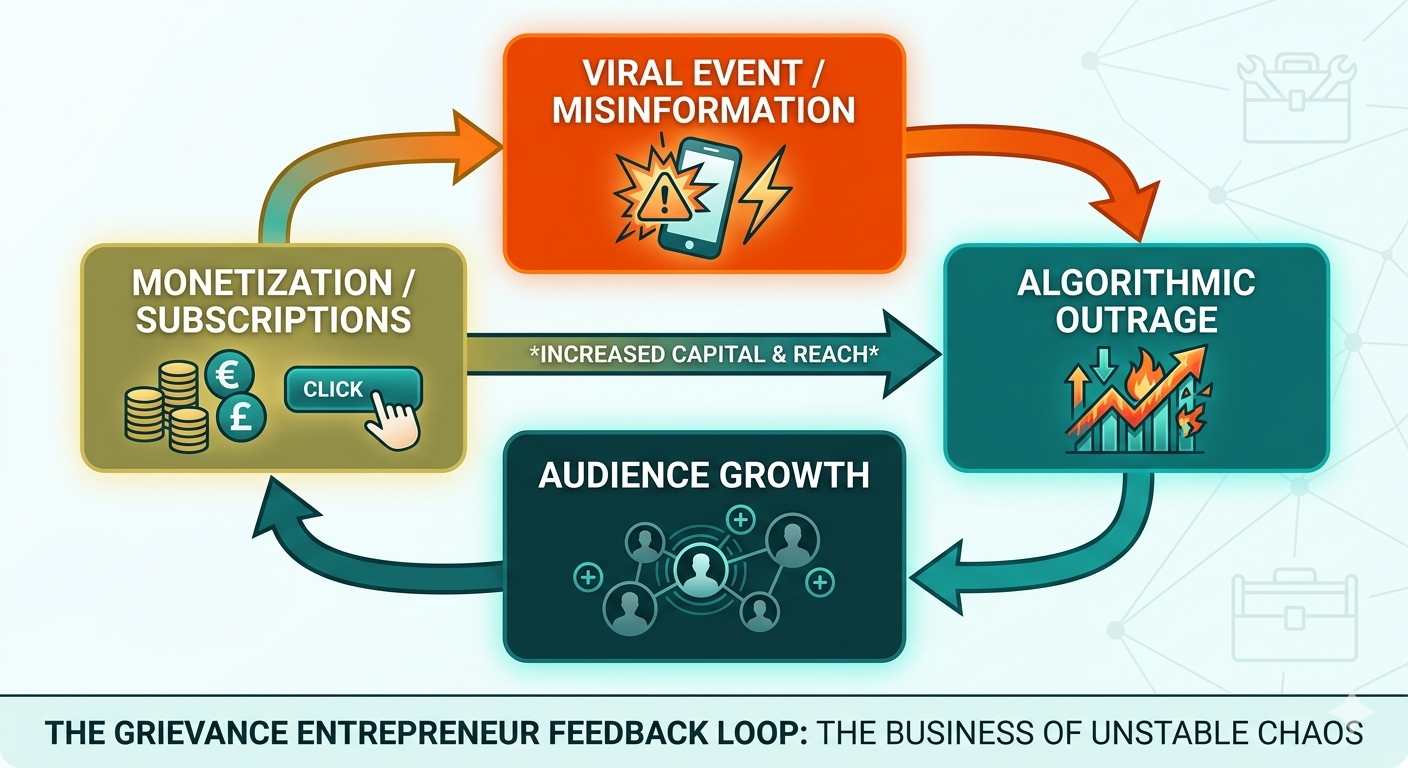
Image generated by Google Gemini.
Statistics and the Truth
A paragraph now on what this essay was not intended to prove or disprove. There is a perennial statistical brawl over whether immigrants commit crime at higher, lower, or identical rates to the native-born, and the honest answer is that it varies by country, cohort, offence category, and the nature and source of the statistics themselves. The argument here does not depend on the answer, just as the autonomous-vehicle argument does not depend on whether the cars are actually safer yet. What matters is the asymmetry of perception and response: the usefulness of misinformation to those willing to jump the gun, the two standards of forgiveness, the two modes of absolution. That asymmetry persists despite the eventual disclosure of facts. A society that burned houses only when the statistics justified it would still be a society that burned houses.
The People with Standing
Which brings us, finally, to the only people in this story with the moral standing to demand vengeance.
While Belfast burned in his name, Stephen Ogilvie’s family sat at his bedside in hospital. They described themselves as devastated, said their only priority was his recovery, and thanked the first responders and the local residents who had intervened to help him. Then they did the one thing the mob could not metabolise: they refused the offering. They asked, explicitly, that the attack on their loved one not be used to fuel hostility towards others, insisting that peaceful protest was the only way forward. The men burning houses claimed to act on the victim’s behalf. The victim’s family looked at the fires lit in his name and said: not in our name.
I think often of that Fiat, broken down on the shoulder of a Nevada highway, and of why we loved it anyway. We forgave that car everything — every shredded belt, every electrical tantrum — because its failures were familiar, predictable, ours. That forgiveness is not a weakness; it is the glue that lets imperfect humans share roads, towns, and countries with one another. The question this decade keeps asking, from Southport to Ballymena to Belfast, is not whether our societies will suffer errors. Every system errs; every population contains its broken men somehow. The question is which errors we have decided, in advance, that we will refuse to forgive — and whether we are honest enough to admit that the deciding factor was never the error at all.
Kind Regards,
Devin Savage
Tübingen DE & Dublin, Ireland.
Research assistance using Claude.ai and Google’s Gemini.
*Note: Doing a cold, rational risk-benefit analysis takes a lot of mental energy. So, our brains take a shortcut: we consult our current emotional state—our “affect”—instead. Think about flying versus driving. Statistically, driving a car is one of the most dangerous things the average person does every single day. Flying in a commercial airliner is incredibly safe. Yet, millions of people get anxious when a plane takes off, while they happily eat a burger and text while driving 70 miles an hour on the highway.
Why? Because of the affect heuristic. When you’re behind the wheel of a car, you feel in control. You have agency. That positive feeling of control tricks your brain into thinking the risk is low. But when you step onto an airplane, you surrender your control to a stranger in a cockpit and a massive machine. That feeling of helplessness creates anxiety, and your brain instantly inflates the risk, making the plane feel way more dangerous than it actually is. The government bureaucrat or system who allowed the immigrations to take place gets the blame for the “disaster.”
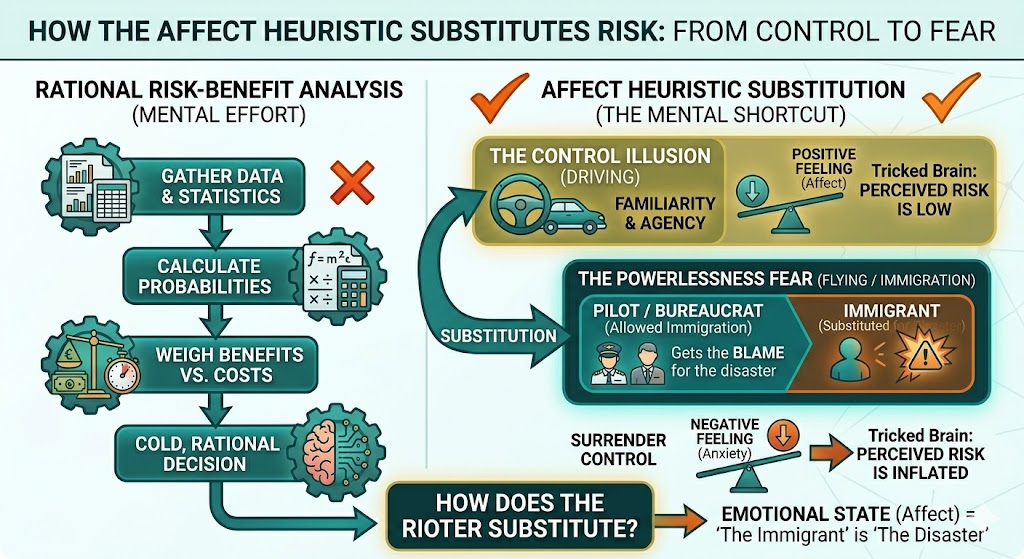
Image created using Google’s Gemini