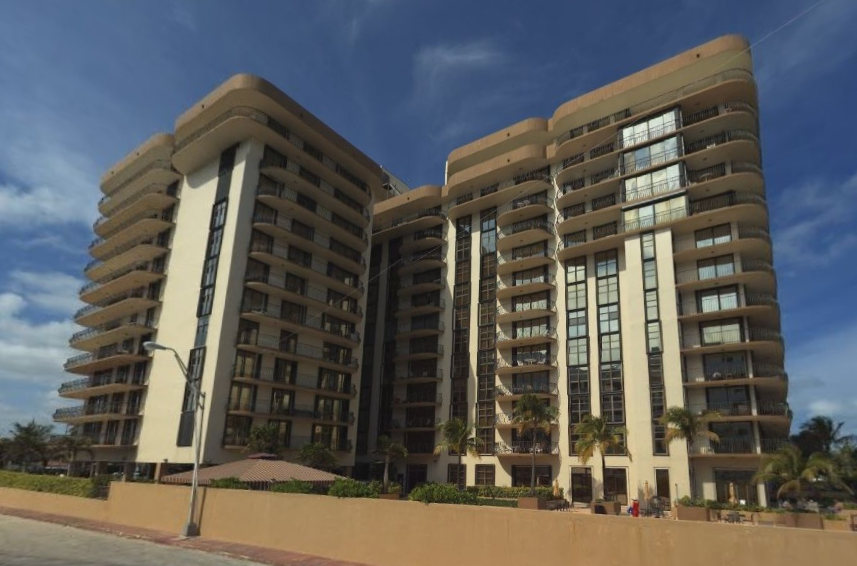
A well-known Florida condominium building was becoming a bit threadbare at forty years old. But it was never considered to be well-constructed nor well-maintained. An upper deck holding an elevated pool was resting on a concrete slab which didn’t even pass code when it was new, built right at the edge of a neighbouring jurisdiction. The tattered, corroded, and compromised structure was out of wiggle room. Then a luxury condo building went up right across the street. Piles were driven into the earth to provide a stable platform for the new building without regard to the condition of the neighbouring older structure. Residents noted and reported intense shaking, mini-quakes and cracks in the walls. The red flags went up, but the building came down anyway.
The only way to PROVE a crash will occur is to indeed allow that crash to occur. The big question here is: do we have the ability to make needed fixes through good leadership- or must we wait until a crash makes those fixes urgent and necessary? We risk so much more by waiting…
Devin Savage
dnaofdisaster.com | July 11, 2026
There is a particular flavour of disaster that doesn’t announce itself. It doesn’t arrive as a bolt from the blue, an ‘act of God’, or even a failure of imagination. It arrives on schedule, having sent word ahead of itself repeatedly, politely, for years — and having been ignored just as repeatedly and just as politely in return. I call this supervised neglect: the condition in which a known risk is not merely tolerated but actively, institutionally watched — logged, reported, recorded, perhaps even discussed — before it is eventually filed and even forgotten, and left to run its course despite all the red flags.
It is a harder thing to reckon with than ordinary negligence, because it nullifies the easiest excuse in the postmortem. I’m sure you’ve heard it before, that familiar alibi: “We didn’t know.” But if the authorities were watching the whole time, somebody knew. The whole apparatus of oversight was switched on, functioning exactly as designed, dutifully recording the warning signs — journalists even writing about it in the newspapers or discussing it on podcasts— and none of that machinery translated into the one thing that mattered, which was somebody, somewhere, was in a position to pull the plug. Apply the brakes. Reach for a functioning veto node I am always mentioning, then make the fix and avoid the disaster.
Two case studies, decades and several thousand miles apart, make the pattern almost embarrassingly legible: the Concorde crash of the summer of 2000, and the collapse of the Champlain Towers South condominium in Surfside, Florida, in June 2021.
The Shaking of a House of Cards
On 24 June 2021, at approximately 1:22 a.m., a major portion of the twelve-storey Champlain Towers South condominium in Surfside, Florida, collapsed suddenly, killing ninety-eight people. But someone had already flagged the building as being in exceptionally poor condition.
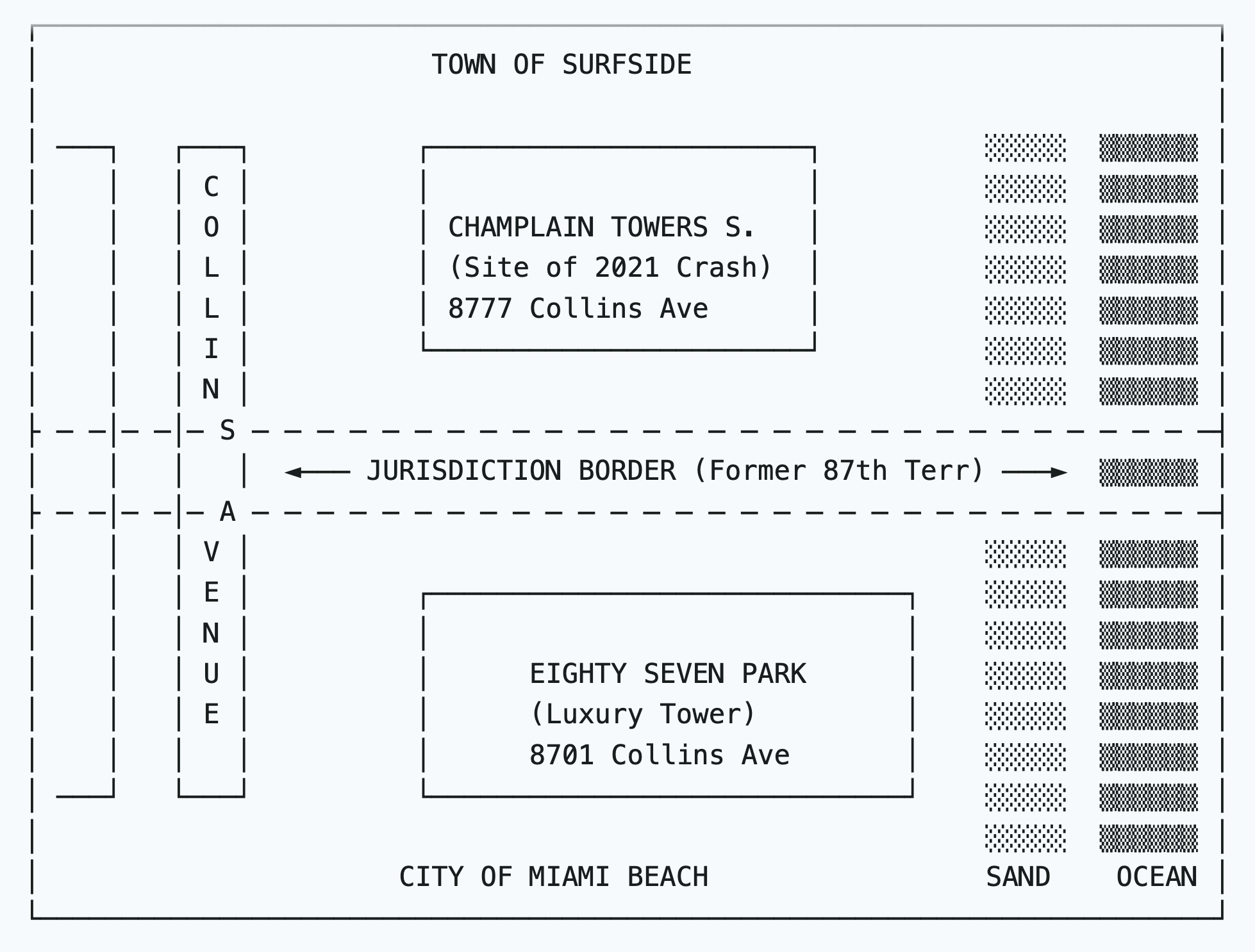
Image generated by Google
The Setting
Picture the southern boundary of Surfside, Florida, where a political border separates it from Miami Beach. On one side stood Champlain Towers South — a forty-year-old concrete structure suffering from decades of saltwater corrosion, neglected maintenance, and original design flaws that left it with dangerously low margins against failure. It was an ailing building, holding its breath until structural renovations could be completed. But its environment was about to change, suddenly, for the worse.
Directly Across the Street
Just across that invisible jurisdictional line, a luxury eighteen-storey high-rise known as Eighty Seven Park was being pounded into existence. To build it, developers drove massive sheet piles forty feet deep into the earth. For months, the residents of Champlain Towers South didn’t just hear the construction — they felt it. Seismographs placed along Champlain’s southern wall recorded ground vibrations that frequently blew past the developers’ own conservative safety thresholds. Residents complained of seismic-like “quakes” rattling their windows and cracking their floor tiles.
Structural Deficiencies
The structural failure of Champlain Towers South stemmed from a combination of original design errors, including an under-designed pool deck and insufficient column-and-slab connections. Construction deficiencies, such as improperly placed rebar and increased dead loads from an added unauthorised penthouse, added greater loads and further weakened the structure and ensured it failed to meet code requirements, according to reports.
The Under-Sized Pool Deck Support
The true ground zero of the collapse was the plaza pool deck and the underground car park directly beneath it. The deck was severely overloaded. Built in 1981, it already suffered from razor-thin safety margins owing to severe deviations from the local building code. Adequate waterproofing was never carried out to shield the steel skeleton of the building from the salty surf, and that exposure allowed saltwater spray to corrode the internal rebar for forty years. Over the decades, the condo association added thick paving stones and massive concrete planters on the deck surface. Combined with the weight of a water-filled swimming pool, the deck had become a ticking time bomb — and this is where a 2018 engineering report, commissioned as part of a routine forty-year recertification, found “major structural damage”: cracking consistent with water intrusion, rebar exposed and deteriorating, and an explicit recommendation that repairs not be deferred.
They were deferred. For three years, the condo board weighed the recommendation against the cost — reportedly running into the millions, to be split among the building’s roughly 135 unit owners — and the arithmetic of an unpopular special assessment did what arithmetic like that generally does. Meetings were held. Estimates were revised.
Timeline of the Final Weeks
For three weeks before the collapse, undiagnosed cracks spread across the slab, shifting immense weight onto neighbouring connections that could not bear the increased loads. At approximately 1:15 a.m. on 24 June 2021, the southern edge of the pool deck finally unseated itself from the perimeter wall. The entire deck caved into the car park below. This massive loss of horizontal stability compromised the base columns of the tower’s middle section, triggering a progressive, top-down collapse of the apartments just seven minutes later.
Because the collapse occurred at 1:22 a.m., most residents were asleep when the building fell. Survivors in the remaining, sheared-off portion described a sound like continuous thunder or a severe earthquake. Within seconds a dense plume of white concrete dust and pulverised drywall filled the air, dropping visibility to zero. Power cut out instantly. Fire alarms shrieked through the darkness, glass shattered, and water rushed from burst mains in the car park below. Survivors used their phone torches to navigate buckled hallways that now ended abruptly in mid-air drops onto the rubble pile, guiding one another down the surviving stairwells, while outside, bystanders and first responders could only watch a building that looked as though it had been cleanly sliced in half, living rooms and beds left exposed to the night air.
Investigation and the 2026 Report
The Town of Surfside retained independent structural specialists, including forensic investigator Allyn Kilsheimer, to carry out standalone vulnerability reviews of the twin North and East towers. Concurrently, the Miami Herald’s award-winning House of Cards investigation served as a crucial public-facing accountability effort, sourcing thousands of pages of historic blueprints and original permitting logs.
Operating with an authority not unlike the aviation world’s NTSB, the National Institute of Standards and Technology (NIST) took the technical lead. Its National Construction Safety Team — co-led by Judith Mitrani-Reiser and Glenn Bell — spent five years modelling the structural physics of the collapse, cataloguing over six hundred pieces of evidence to reconstruct a three-week progressive failure.
NIST released its final technical findings in June 2026. The collapse, it concluded, did not happen in a single night. The structural failure actually began three weeks earlier, in early June 2021, when two critical connections between the underground garage columns and the pool deck slab gave way entirely. The mechanism was a phenomenon known as punching shear: rather than bending gradually, the heavily burdened concrete slab fractured abruptly around the support columns, allowing the vertical columns to punch straight up through the horizontal floor. And the report drew a direct line to the construction across the street — the pile-driving for Eighty Seven Park had produced ground vibrations exceeding safety thresholds by as much as 1.5 times between 2016 and 2019, vibrations believed to have acted as a catalyst, destabilising the already compromised pool deck and accelerating its failure.
The Concorde Parallel (A Textbook Case of Supervised Neglect)
The First Blowout
Concorde’s tyre problem did not begin with the crash outside Paris in July 2000. It began on the aircraft’s very first test flight in 1969, when a tyre blew on landing. Over the following three decades, the fleet racked up something in the region of seventy tyre-related incidents — blowouts, deflations, fragments of rubber punching through the wing and fuel tanks with enough regularity that engineers had, in effect, a standing item on the agenda. This was not a mystery. It was a maintenance category.
What Concorde had, and what most disasters of this kind have, is a structural excuse for inaction dressed up as an organisational feature on an international scale. The programme was a joint venture between the French and British governments; engineered, certified, and operated across two sovereign aviation authorities, two national manufacturers, and two sets of political stakes. Grounding the fleet, or forcing a redesign, required somebody on one side of the Channel to unilaterally tell the other side that their shared, prestige-laden, taxpayer-subsidised achievement had a flaw serious enough to stop flying it. Nobody was positioned to say that. The design of the governance was as much a cause of the eventual crash as the design of the wheel well and the tyres.
This is the mechanism I’ve previously described as the missing veto node — the point in a system where someone with both the authority and the standing to say “stop” is supposed to sit, and either doesn’t exist or has been quietly disempowered. But Concorde adds a second layer worth naming on its own: the Andon cord* that’s career-ending, not just uncomfortable. In a well-designed manufacturing system, any worker can pull the cord and halt the line the moment something looks wrong, no career risk attached. Concorde was a Cultural Monument in the fullest sense — a shared national achievement, a rebuke to American aviation dominance, a symbol two governments had staked their industrial credibility on. Pulling that cord would not have stopped just a plane. It would have stopped a story two countries were still telling themselves about who they were. Seventy incidents in, the story was still winning.
What the Repetition Is Actually Doing
The detail that links these two cases most tightly isn’t the warning. Single warnings get missed all the time; that’s ordinary human error, and it’s forgivable in a way supervised neglect is not. What links Concorde and Surfside is the repetition, and what repetition does to risk perception once an institution starts supervising rather than solving.
Seventy tyre incidents without a hull loss didn’t make Concorde’s tyre problem more urgent. It made it more normal. Years of vibration complaints and a cracked-slab report, revisited at board meeting after board meeting without a collapse, didn’t make the danger feel more pressing — they made it feel like a formality that had already been priced in. Every non-catastrophic repetition of a known risk quietly recalibrates the baseline for what counts as an emergency, eroding the very faculty an inspection regime exists to protect.
Notice, too, that the two cases fail through opposite ends of the same veto node. Concorde’s veto node was structurally absent — nobody, by design, held the unilateral authority to ground a binational fleet. Surfside’s board had exactly the authority Concorde’s regulators lacked: it could levy an assessment and order the repair outright. What it lacked was the social nerve to use that authority. Pulling this Andon cord* didn’t threaten a national monument; it threatened to make one board member the person who told 135 households, several on fixed incomes, that they each owed tens of thousands of dollars for a problem most of them had never seen and would rather not believe in. The golden handcuffs did the rest — Concorde’s operators had built a commercial identity around supersonic prestige; Surfside’s board had built three years of institutional inertia around the assumption that a building that hadn’t fallen down yet probably wasn’t about to. One veto node was missing by design. The other existed and simply lost its nerve. Either way, supervised neglect got its final outcome.
Two Scales, One Default
The instinct is to treat Concorde as a story about aviation bureaucracy and governmental gridlock, and Surfside as a story about deferred maintenance and homeowner economics — different genres, different actors, different stakes. But the mechanisms both point to the same cognitive trap — regardless of the scale. An aerospace programme with dual nationalities involved, regulators, ministers, and a fleet of supersonic jets, and a volunteer condo board with a shared pool and budget for decorating and landscaping arrived at the identical failure mode: watch, document, defer, repeat, and hope the day of disaster never comes — the familiar ‘fool’s paradise.’
Supervised neglect isn’t a failure of the flow of information. Both systems had the information, in writing, years in advance. It’s a failure of the one person in the room being willing to say, out loud, in front of everyone who has a stake in the outcome: “we must stop now.” Whether that person is a French aviation minister or a homeowner on a condo board, the job description is depressingly the same — and depressingly rare. The crash is unproven until it isn’t, and the fool’s paradise only lasts until the crash.
Kind Regards,
Devin Savage
Tübingen, Germany & Dublin, Ireland.
Research assistance using Claude.ai and Google’s Gemini.
—
Sources
Miami Herald, House of Cards investigation: https://www.miamiherald.com/news/special-reports/surfside-investigation/article255411881.html
Savage, Devin. 2025. The DNA of Disaster: Catastrophe by Design. Karlier LLC
Punching Shear: https://www.youtube.com/watch?v=wYxXqzLlxZs
* Toyota’s Andon Cord https://www.youtube.com/watch?v=Gv_Kh7zPuF4