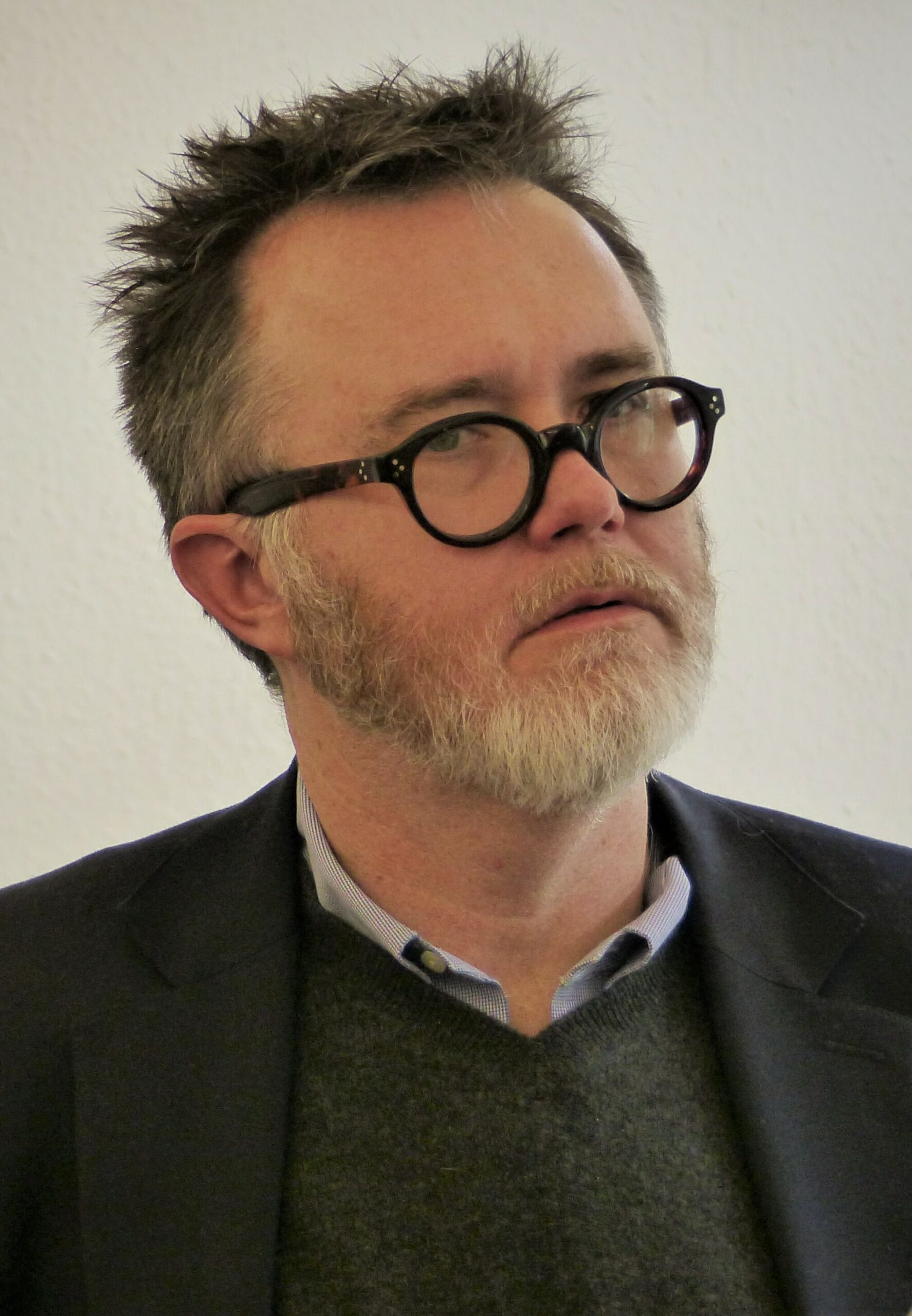
Photo Credit: Elekes Andor, via Wikimedia Commons
Devin Savage
Part One: The Prophet of Discontent
Looking at Rod Dreher from my perch in Germany lends me — at least in part — a certain kinship with him. He left the US for Hungary. I left the US for Germany. But there the comparison breaks down in a way that matters. Dreher settled in a country that has been systematically dismantling its democratic institutions under Viktor Orbán. I settled in one that, after the catastrophic failure of the Weimar Republic and everything that followed, rebuilt itself, with plenty of American encouragement, from the rubble on democratic foundations and has been making those foundations stronger ever since. We both chose exile. We did not choose the same destination, and that difference is not trivial.
It’s not that I dislike or want to disown the United States — I hold dearly the ideas the country was founded on. But I’ll be honest: those ideals are alive and well in Europe, and in Germany too. The US has long been that example, the beacon on the hill we should all be striving towards. However, the very apparent kinks in the armour — the flaws in the design of the Republic — make me feel that there are still so many ways it could all go wrong. And far fewer mechanisms to keep America on the straight and narrow than there used to be.
Who Is Rod Dreher Anyway?
On an April evening in Washington, D.C., J.D. Vance stepped to a podium at the Heritage Foundation and told the crowd that he would not be the Vice President of the United States if not for his friend Rod. He praised the man for ten minutes. Then the two embraced on stage, each saying “I love you, man.” Most Americans watching the news that week had never heard of Rod Dreher. They should have. The man hugging the Vice President has spent two decades building the intellectual architecture that may well define the next Republican presidency — and with it, the future of American democracy itself.
Dreher is not a politician. He holds no office and seeks no office. He is a writer — a blogger, essayist, and author of several books that have become touchstones of the American religious right. He lives alone in Budapest, writes for hours each day in coffee shops, and describes himself, with a winking self-deprecation, as “Your Working Boy.” But his influence on the people who do hold power is real, documented, and growing. Understanding Rod Dreher is not an exercise in fringe-watching. It is preparation for what may come.
To get a sense of the range of his platform, consider a recent guest post on his blog at The American Conservative by Jack Hunter, entitled “On the Iran War, They Think You’re Stupid.” Even the most tree-hugging matcha-latte-drinking liberals will give pause to his criticism — because he is correct, not just ‘right’ in his point of view- on that matter. This is Trump’s “Mission Accomplished” moment we are witnessing right here, ladies and gentlemen. The American President, the one who just months ago had sent Elon Musk to do ‘surgery’ on the so-called deep state with a chainsaw, was attempting to sell a surgical strike on a Muslim Theocracy — the world’s most notorious one, the one trying to get their hands on nukes, the one who — you have to admit — does not pose much of an imminent threat to the USA. But does indeed, as Iran has confirmed many times, pose a threat to Israel: the client state of the USA, almost an outpost of the United States right in the middle of the Middle East.
It’s been less than a year since Trump and Israel struck Iran’s nuclear sites. Trump cites events from the past 47 years — the Iran hostage crisis, the 1983 Marine barracks bombing, the 2000 attack on the USS Cole — as grounds for a strike. Regime change, indeed. But does an identifiable historical pattern really warrant this now? Have we ever, in our history, successfully passed the baton of democracy to a country under such an oppressive theocratic regime? We haven’t had much success at democracy-building since the aftermath of the Second World War. We failed in Korea, Vietnam, Afghanistan, Iraq, and Libya. Japan and West Germany were the early successes, and they came at a cost that beggars the imagination. What are our chances now? Did the Neocons somehow get to Trump’s ear? That this kind of analysis appears on Dreher’s platform, alongside his more mystical prescriptions, is part of what makes him interesting and perhaps dangerous in equal measure.
The Man Behind the Ideas
Dreher grew up in St. Francisville, Louisiana, population 1,557, the only son of a rural public-health officer who seems to have regarded his bookish, Europe-dreaming boy with a mixture of bafflement and contempt. Ray Dreher was a stubborn authoritarian who expected his children to stay. Rod left as soon as he could. His father, by some accounts, was a member of the Ku Klux Klan. He never really forgave his son for getting out.
This rejection became the wound around which Dreher’s entire life and worldview organised itself. He returned to St. Francisville as an adult, hoping to reconcile, drawn back by the death of his beloved sister Ruthie and the sense of community her funeral revealed. The return was a spectacular failure. His father refused to relinquish his grudge. For four years afterward, Dreher was mostly bedridden with chronic mononucleosis, sleeping half the day away. “The thing that I wanted more than anything else in the world,” he wrote years later, “is to feel at Home in this world, with a father who approves of me. That was not to be mine.”
There is a story that anyone who knows Dreher’s work has heard: the bouillabaisse story. He prepared the French fish stew for his family, and they refused to eat it. It wasn’t the Louisiana country cooking they knew. His father nursed a grudge over it. To outsiders, this sounds trivial. To Dreher, it became “the iconic moment” in his relationship with his family — the moment that crystallised his understanding of tribal loyalty, cultural belonging, and the price of being different. He has written about it in multiple books. It has never stopped haunting him.
His religious life followed the same pattern of longing, commitment, and disillusionment. He was raised a “Christmas-and-Easter Methodist,” converted to Catholicism in his mid-twenties, then left the Church in 2006, disgusted by its handling of the sex-abuse scandal — “like having my faith pulled out of me by my fingernails.” He became Eastern Orthodox. His marriage eventually fell apart. He is now largely estranged from two of his three children.
The man who preaches the virtue of “fixed place and way of life,” who draws inspiration from Saint Benedict’s stable sixth-century monasteries, who exhorts his readers to put down roots in committed communities — lives as a rootless exile, alone in a foreign city, his family scattered, his friendships mostly conducted through a screen. This is not hypocrisy in the ordinary sense. It is something more revealing: a man trying to prescribe for the world the medicine he cannot administer to himself.
What He Actually Believes
It would be easy — and wrong — to dismiss Dreher as a crank. Some of his observations about modern life are genuinely acute. His diagnosis of loneliness, of the way the internet has dissolved community, of the spiritual emptiness that hides behind infinite consumer choice — these resonate across the political spectrum. When he describes the modern online world as a “vast disenchantment machine,” he is identifying something real. Even Richard Dawkins, the world’s most famous atheist, now describes himself as a “cultural Christian,” uncomfortable with the vacuum that aggressive secularism has left behind.
But Dreher does not stop at diagnosis. His prescription is where things get dangerous. He does not believe the problems of modern life can be solved by better policy, or wiser leadership, or a renewed civic culture. He believes the philosophical foundations of modern Western society are themselves rotten — that the Enlightenment was not progress but a wrong turn, that liberal individualism and scientific rationalism have done more harm than good, that democracy itself is a symptom of the disease rather than the cure.
The big reveal is his hatred of the Panthéon — the building in Paris where France buries its greatest secular heroes. A physical monument that houses France’s Cultural Monuments. Dreher walked past it with a journalist and said, flatly, “I hate the Panthéon.” It is an emblem, he explained, of the secular faith that spread after the French Revolution, proof that the rot in contemporary Europe goes all the way back to the Enlightenment itself. He speaks of the revolutionary mobs of 1793 as though they swept through yesterday. His compass does not point toward the American Founding Fathers. It points before them — before Locke and Rousseau and Jefferson — back to what he calls the “luminous medieval wholeness” of pre-Enlightenment Christian Europe, when “the entire universe was woven into God’s own Being.”
This is not American conservatism in any traditional sense. American conservatism, at its best, seeks to preserve the constitutional order — the Founders’ settlement, the Bill of Rights, the separation of powers. Dreher’s project is categorically different. He is a reactionary in the strict sense: he wants to reverse the operating system entirely. To go back not to 1776, but to 1276. This is not just an idiosyncratic spiritual project; it is a blueprint for a form of cultural protectionism that has never had a better chance to become codified into ‘scripture’- in the same way the Second Amendment has been elevated to untouchable sanctity. The Trump wrecking ball has laid to waste our democratic immune system- and now is his best opportunity to pound this nail in. And he has found, in J.D. Vance, a political vehicle capable of carrying those ideas toward actual power.
The Vance Transmission Vector
The connection between Dreher and Vance is not speculative. It is documented and publicly acknowledged. Dreher latched onto Vance’s memoir Hillbilly Elegy when it was still obscure, promoted it relentlessly on his blog, and helped vault the book onto the bestseller list. The two became close — at least outwardly — as Dreher became a friend and adviser while Vance launched his political career. When Vance attended the Munich Security Conference as a first-term senator in 2024, he left early to reconnect with Dreher — who had come from Budapest — over beer and sausages. A year later, Vance returned to Munich as Vice President and delivered a speech accusing European leaders of betraying their own civilisation, warning of mass immigration’s dangers, attacking the arrogance of the EU’s ruling elite. The Atlantic’s profile of Dreher notes that the speech “could almost have been written by Dreher.”
The Trump administration’s 2024 National Security Strategy went further, warning that Europe was in danger of “civilisational erasure.” That phrase — “civilisational erasure” — is Dreher’s language, Dreher’s framework, Dreher’s essentially pre-democratic worldview, now embedded in official American foreign policy.
J.D. Vance, at forty years old, is still near the beginning of what may be a very long political career. Already the Vice President of the United States, he has publicly credited Dreher with his meteoric rise. Whatever comes next in American politics, the ideas of a lonely exile writing in Budapest coffee shops are already shaping it. That is why Dreher matters. That is why his story — the father who rejected him, the families he abandoned, the communities he praised but could not inhabit, the medieval wholeness he longed for but could not find — is not merely personal. It is, increasingly, political. And this brand of politics is coming for all of us.
Part Two: The Assumptions of a Free Society
Democracy, Self-Governance, and the Authoritarian Temptation
Back in 2022, an essay by Leighton Woodhouse in The Free Press caught my eye. Having grown up on the West Coast, I — however wrongly — think of the entire western coast of the USA as a bastion of progressivism. I know logically this is not true: California, with its population of over 30 million, has more registered Republicans than any other state. But I like to think of Oregon especially as a progressive, forward-thinking state. Yet Woodhouse describes growing discontent within the Democratic majority. Homelessness and crime signalling incompetence in local officials. A drug policy that has not lived up to its promises — the legalisation of small amounts of hard drugs, without the infrastructure for treating the addiction that drives their use. The lapses of policing on the streets. The sense that public safety has simply been abandoned as a civic value. Could the ranks be thinning? Were Democrats losing the faith of their own people?
Consider Linda Donewald, who moved to Portland, Oregon because her husband dreamed of living on the river. She loved the city’s history, its restaurants, its Saturday market on the waterfront. Then the homeless encampment appeared across the street. Then the gunfire became routine. Then someone walked into her neighbour’s floating home and took a shower in his bathroom. When residents tried to get the city to act, they were bounced between unresponsive agencies until a legislative aide suggested they organise a barbecue for the homeless.
Donewald’s frustration is not a political pathology. It is a completely human response to genuine disorder. The feelings of helplessness, the emotions- the frustration- is legitimate. When the systems that are supposed to maintain civic life fail — when the police don’t come, when the government doesn’t respond, when the street outside your window looks like a war zone — the desire to hand power to someone who will simply fix it is not weakness. It is instinct. It is the oldest political instinct there is.
But that instinct, left unexamined, leads somewhere that history has charted with terrible consistency. Before we follow it, we ought to read the map- and the history books.
The Social Contract Nobody Read
Liberal democracy rests on a set of assumptions so fundamental that most people have forgotten they exist. The most important of these is that human beings are capable of governing themselves — not perfectly, not always wisely, but sufficiently. That the ordinary citizen, given freedom and accountability, can be trusted to run his own life without a minder. That the disorder this produces is not a failure of the system. It is proof the system is working.
In law, release on recognisance means the court trusts you to appear without requiring a bondsman to watch you. Democracy extends that trust to an entire society. Every citizen is, in effect, released on their own recognisance — trusted with their freedom on the assumption that they will, most of the time, use it responsibly. The drunk, the addict, the man who takes a gun to a protest and fires it when he feels threatened — these are the costs of that trust, the price we pay for the freedom to err, the freedom to be human. They are not signs of the apocalypse, nor reasons for ending the experiment. They are the experiment, in its most uncomfortable form.
The question democracy always has to answer is not “how do we eliminate all disorder?” That question has no democratic answer. The question is: at what point does the disorder outweigh the cost of the cure? And to answer that honestly, we need to be very clear-eyed about what the cure actually costs.
The Protector’s Bargain
Dreher’s worldview, and by extension Vance’s political philosophy, rests on a simple premise: human beings cannot, in fact, govern themselves. Without external authority — the Church, tradition, a strong leader, a fixed moral order — we are vulnerable. Our freedom produces only loneliness, addiction, disorder, and what Dreher calls “liquid modernity,” a world in which nothing is solid and everything dissolves. The solution, in his framework, is to surrender a portion of that dangerous freedom to a protector capable of imposing the order we cannot impose on ourselves.
This is the oldest authoritarian pitch in the book, and it is always superficially plausible. Order is visible. The encampment being cleared, the crime rate dropping, the streets feeling safe again — these are things people can see and feel. What is harder to see is what has been quietly removed in exchange: the mechanisms that would allow you to hold the protector accountable when he eventually, inevitably, abuses the power you gave him.
Here is the thing that Dreher’s framework cannot accommodate: the protector is not a special category of human being. He is not an Übermensch. He is not a god in human form. He is not drawn from different stock. He faces the same temptations as the ordinary citizen — greed, tribalism, vengeance, the desire to punish enemies and reward allies — and he faces them at vastly greater scale, with vastly fewer consequences. The man on the Portland street tempted to steal a catalytic converter is a nuisance. The leader tempted to steal a country is a catastrophe. And the catastrophe is harder to reverse, because the tools for reversing it — the free press, the independent judiciary, the opposition party, the right to protest — are precisely what the protector dismantles first.
What History Actually Shows
Dreher has praised Viktor Orbán as “a real visionary” and credits him with rescuing Hungary’s social and cultural integrity by limiting immigration. He has been affiliated since 2021 with the Danube Institute, a state-backed think tank that disseminates Orbán’s political ideas. Through his friendship with Tucker Carlson, Dreher helped arrange an Orbán interview that sent a stream of American conservatives on pilgrimage to Budapest, making “the Hungarian model” a standard reference point in Trumpian politics.
What is the Hungarian model, in practice? Dismantled independent institutions. A captured judiciary. A media landscape brought largely to heel. Rampant corruption. A weak economy. Systematic subordination to Vladimir Putin. The immigration problem that justified the emergency measures remains largely unchanged. But the mechanisms for holding Orbán accountable have been systematically removed. That is the bargain: an authoritarian leader will give you the feeling of having a protector, but you lose the tools to protect yourself from him.
Dreher praises all of this from a comfortable distance. He can advocate for radical transformation of Western societies while living in a city whose coffee shops suit his writing routine, insulated from the consequences of the model he promotes. This is the pattern that runs through the entire authoritarian tradition: the intellectuals who supply the justifications are rarely willing to subject themselves to the resulting system. Dreher himself has identified this pattern in other contexts — decision-makers divorced from the environmental consequences of their decisions. He simply does not recognise himself in the description.
The Authoritarian System Hides Its Disorder
Do you remember the obfuscation that happened around Chernobyl? The Soviet regime allowed radioactive particles to spread around Europe for two days before the Swedish discovered the leak at a nuclear power plant 60 miles north of Stockholm- about 600 miles from Chernobyl.
One of the most important things to understand about authoritarian governance is that it does not eliminate disorder. It hides it, relocates it, concentrates it, and removes the mechanisms for addressing it. Democratic disorder is visible precisely because democracy does not hide it. The homeless encampment in Portland is a political problem that can be argued over, voted on, litigated, and eventually resolved. The corruption in Budapest is protected by the very institutions that were supposed to prevent it.
An authoritarian system obscures by design. The gulag is not in the tourist brochure. The political prisoner’s sentence is not discussed at the Heritage Foundation luncheon. The cronyism that enriches the dear leader and his allies while ordinary people struggle is explained as the price of stability, or as the work of foreign saboteurs, or as a necessary transitional hardship on the way to the glorious restoration — which never actually arrives. And because the press has been captured, the judiciary compromised, and the opposition marginalised, there is no mechanism left to contest the pretzel logic of the explanation.
This is the point that gets lost in the frustration of people like Linda Donewald, and Diana Sapera, and the lifelong Democrats of Portland who voted for a Republican because they couldn’t stand the encampment across the street. Their frustration is legitimate. Their instinct to demand better governance is healthy. What is dangerous is the leap from “this government has failed” to “we need a stronger protector.” The first is a democratic grievance with democratic remedies. The second is a surrender of the very tools needed to address grievances in the future.
The Price of Getting It Back
Some years ago I remember a patient of mine telling me that British Hong Kong was a fantastic place. He equated it to Silicon Valley — a place where like-minded individuals could gather, and commerce, culture, and ideas could flourish. Nobody stood in their way. There was no veto player who could shut it all down, at least not yet.
Jimmy Lai ran one of Hong Kong’s most widely read newspapers and spent years fighting for the right of Hong Kong citizens to govern themselves. He watched, in real time, as the mechanisms of democratic accountability were dismantled one by one. He kept writing. He kept organising. He kept arguing that the citizens of Hong Kong were capable of self-governance, that they could be trusted with their own freedom, that the disorder of a free society was preferable to the order of a controlled one. At 78 and in ill health, he is now serving a twenty-year prison sentence.
Lai understood something that comfortable Americans are in danger of forgetting: democratic freedom is not the default state of human societies. It is an achievement, maintained against constant pressure, requiring active defence. Once surrendered, it does not come back easily or cheaply. The history of the twentieth century is largely a record of what it costs to recover freedoms that were handed away in moments of frustration, fear, or the simple desire for someone to just fix things.
Rod Dreher is a sincere man in genuine pain, reaching for something real — community, rootedness, meaning, a world that holds together. His diagnosis of the diseases of modernity is not entirely wrong. But his prescription requires dismantling the operating system of free societies and handing the controls to protectors who have no special immunity to the temptations of power. History’s verdict on that experiment is unambiguous and written in the suffering of millions.
J.D. Vance is forty years old and has the ear of the most powerful office in the world. The ideas Dreher gave him — civilisational crisis, the betrayal of Western heritage, the need for strong leaders willing to break things — are not abstract any more. They are policy. They are rhetoric. They are the lens through which an increasingly powerful political movement understands the world.
A free society is messy. People exercise their freedom badly, sometimes catastrophically. The street outside Linda Donewald’s floating home was genuinely frightening, and her government genuinely failed her. All of that is true. But the mess is also the proof that the experiment is real — that people are actually free, that their choices actually matter, that no one has yet taken from them the right to live on their own recognisance.
The moment you hand that right to a protector, you have made yourself smaller, weaker, and dependent on his judgement in perpetuity. You have not solved the problem of human fallibility. You have concentrated it in a single pair of hands, removed the mechanisms for checking it, and called the result order.
It is not order. It is the oldest catastrophe in the human story, wearing a new face.
Kind Regards,
Devin Savage
Tübingen
Research assistance using Claude.ai and Google’s Gemini.